

Updated November 2026
You know to be skeptical about things you read on the internet, right? Just because something appears on Google doesn’t mean it’s accurate or that it’s coming from a trustworthy source. Unfortunately, scammers know that many travelers turn to Google when they need help, especially when their flights are delayed or canceled and they’re desperate to speak with an airline representative.
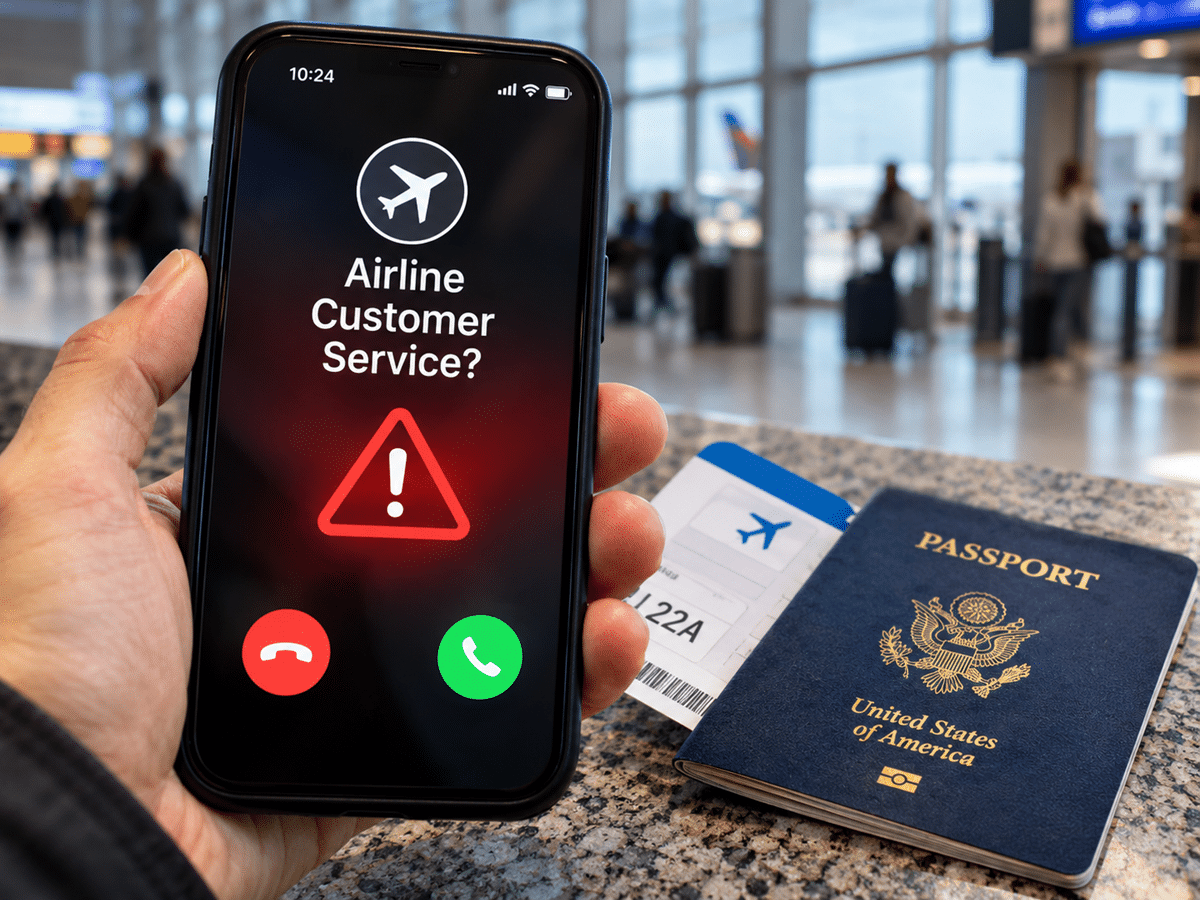
One traveler learned this lesson the hard way when he searched for Delta Air Lines’ customer service number after his flight was canceled at New York’s John F. Kennedy International Airport (JFK). Instead of reaching Delta, he ended up speaking with a scammer who tried to charge him five times the price of his original ticket.
The incident happened in July 2023, but the scam hasn’t disappeared. In fact, travelers are still being targeted by criminals who post fake airline phone numbers online, impersonate customer service representatives and create convincing websites designed to steal money and personal information.
How a canceled Delta flight nearly turned into an expensive scam
Shmuli Evers, a father of three, was flying out of JFK when his Delta flight was canceled. Like many travelers in that situation, he wanted to get rebooked as quickly as possible. Unfortunately, the customer service line at the airport was enormous, so he did what millions of people would probably do: He pulled out his phone and searched Google for Delta’s phone number at JFK.
He found a number that appeared to belong to the airline and called it. But instead of reaching Delta, he was connected to someone posing as an airline representative.
Evers documented his experience in a series of posts on Twitter, now called X, explaining how close he came to falling for the scam.
At first, everything seemed relatively normal. The person on the phone offered to help him find another flight. When the call disconnected, the supposed representative called him back from a French phone number, which Evers immediately found suspicious.
But here’s what made the scam particularly convincing: After Evers provided his name and confirmation number, the person was apparently able to access his flight information on Delta’s website. The scammer then found an alternative flight departing from Newark later that evening and sent Evers a screenshot of the itinerary.
This is important because many travelers assume that if someone knows their reservation details, they must work for the airline. That’s simply not true. A name and booking confirmation number can sometimes be enough to retrieve or manage a reservation.
The situation became even more suspicious when the person told Evers that he needed to cancel his original reservation and pay for a completely new ticket. That’s when Evers started asking questions. The supposed representative claimed to be in Rochester, New York, but incorrectly described its location. Evers was already uncomfortable with the unusual callback number and the request for additional payment.
He eventually refused to provide his credit card information. The scammer reportedly wanted to charge him five times the price of his original ticket. Fortunately, Evers recognized the warning signs before handing over his payment details. You can read his original post here:
My @delta flight got canceled from JFK. The customer service line was huge, so I google a Delta JFK phone number. The number was 1888-571-4869 Thinking I reached Delta, I started telling them about getting me on a new flight.
— Shmuli Evers (@Shmuli) July 16, 2023
It wasn’t just Delta. Other airlines were targeted, too.
After his experience, Evers investigated further and discovered that incorrect phone numbers were appearing in Google listings for several other airlines at New York-area airports. According to NBC News, the affected listings included American Airlines, Southwest Airlines and Air France, among others.
In other words, this wasn’t simply one traveler accidentally dialing the wrong number. Scammers had managed to manipulate airline contact information appearing in Google results. Evers even posted screenshots showing the suspicious listings. See his American Airlines warning:
Looks like @AmericanAir also has a scammer number listed at JFK. @ScammerPayback this is huge. pic.twitter.com/MfmbkHga05
— Shmuli Evers (@Shmuli) July 16, 2023
After the story made national headlines, Google said it was correcting the inaccurate information, suspending malicious accounts and adding protections against similar activity.
But that doesn’t mean travelers can assume every phone number they find online is legitimate today.
The scam is still happening in 2026
Here’s why I’m updating this article: More than three years after Evers’ experience, travelers are still being warned about fake airline customer service numbers.
In June 2026, ConsumerAffairs reported that scammers were continuing to exploit search results by publishing fraudulent airline phone numbers. Travelers looking for help with canceled flights, schedule changes or reservations were being directed to impostors who attempted to obtain personal information or payment.
And the problem goes beyond fake phone numbers. The Federal Trade Commission has warned that scammers also monitor social media for frustrated airline passengers. When someone posts a complaint about a delayed flight or lost luggage, an account pretending to represent the airline may respond and offer assistance.
The fake representative might ask for a confirmation number, phone number, credit card details or other personal information. In some cases, the scammer sends a link to a fake airline website.
These schemes are especially dangerous because they target people when they’re stressed, tired and trying to solve a problem quickly.
7 ways to avoid fake airline customer service scams
1. Never blindly trust an airline phone number in Google search results
This is the biggest lesson from Evers’ experience. Just because a phone number appears prominently in Google, including in a business listing, doesn’t mean it’s legitimate. Scammers can manipulate listings and create misleading websites or advertisements. Instead of calling a number directly from a search result, go to the airline’s official website or mobile app and find its contact information there.
2. Download the airline’s official app before your trip
I always recommend downloading your airline’s app before flying. Not only can it provide flight status updates, boarding passes and gate changes, but it can also be one of the safest ways to contact customer service. Some airlines even allow you to rebook a canceled flight directly in the app without speaking to an agent.
3. Be suspicious if someone demands additional money to rebook a canceled flight
If an airline cancels your flight, you generally shouldn’t have to purchase an entirely new ticket just to be rebooked on that airline. There are exceptions depending on what you’re requesting, particularly if you voluntarily change your itinerary or switch airlines. But if someone claiming to work for your airline suddenly demands hundreds or thousands of dollars to fix a cancellation, stop and verify the request through an official channel.
4. Don’t assume someone is legitimate because they know your reservation details
This is one of the most important takeaways from Evers’ story. The scammer apparently accessed his itinerary using his name and confirmation number. That made the interaction seem legitimate, but it wasn’t. Treat your booking confirmation number like sensitive information and don’t share it with someone whose identity you haven’t verified.
5. Watch out for fake airline accounts on social media
If you complain about an airline on X, Facebook or another social media platform, don’t be surprised if someone claiming to be from customer service contacts you. Scammers actively look for these posts. Instead of responding to an unsolicited message, visit the airline’s official website and use the social media links provided there. Never share credit card information or passwords through social media messages.
6. Don’t automatically trust sponsored search results or AI-generated answers
Scammers can pay for advertisements that resemble legitimate airline search results, and misleading contact information can also appear in AI-generated search responses. Before calling a number or clicking a link, make sure you’re dealing with the airline’s actual website. Look carefully at the domain name because fraudulent websites often use slight misspellings or extra words to appear legitimate.
7. Save important airline contact information before leaving home
This is something I recommend doing before every big trip. Save the airline’s official customer service contact information in your phone, especially if you’re traveling internationally. If something goes wrong and you’re dealing with a canceled flight, you won’t have to scramble to find a number while standing in a crowded airport.
What to do if you’ve already called a fake airline customer service number
If you realize you’ve been speaking with a scammer, hang up immediately. Don’t continue the conversation, even if the person claims they can fix your reservation or refund your money.
If you provided credit card information, contact your card issuer right away. Explain what happened and ask whether any suspicious transactions can be blocked or disputed. You may also need to replace your card.
If you shared your airline confirmation number or account details, contact the actual airline through its official website or app. Ask whether anyone has accessed or modified your reservation. Change your account password if necessary and enable multifactor authentication when available.
If you clicked a suspicious link or entered personal information on a fake website, take additional precautions to secure your accounts.
You can also report the scam to the Federal Trade Commission at ReportFraud.ftc.gov. If your identity has been compromised, visit IdentityTheft.gov for recovery guidance.
The faster you act, the better your chances of limiting the damage.
My advice: Go directly to the airline
I understand why Evers searched Google for Delta’s phone number. When your flight is canceled and there’s a long line of frustrated passengers waiting to speak with an agent, you want answers immediately. The last thing you want to do is spend another hour standing in line or waiting on hold.
But here’s the problem: Scammers know exactly how desperate travelers can be in those situations, and they’re counting on you to let your guard down.
If I’m dealing with a canceled flight, my first move is usually to open the airline’s app to see whether I can rebook myself. If that doesn’t work, I’ll use the airline’s official customer service channels while also trying to speak with an agent at the airport.
And if someone claiming to represent an airline asks for an unexpected payment, especially through an unusual method, I’m going to verify everything before handing over a dime.
The bottom line is simple: Don’t trust an airline customer service number just because Google displays it. Go directly to the airline’s official website or app.
This is an easy mistake to make, and even experienced travelers can fall for it. Please share this warning with friends and family, especially anyone who doesn’t travel frequently or might not recognize the warning signs.
KEEP READING
- Bank of America Issues Warning About These Common Scams and the Red Flags to Look Out For
- Don’t Fall For These QR Code Scams
- Don’t Fall Victim To Fake Uber Drivers At Airports
Want more travel news, tips and deals? Sign up for Johnny Jet’s free newsletter and check out these popular posts: The Travel Gadget Flight Attendants Never Leave Home Without and 12 Ways to Save Money on Baggage Fees. Follow Johnny Jet on MSN, Facebook, Instagram, Pinterest and YouTube for more travel advice.

to avoid these scammers, before you leave on your trip write down all valid phone number from the valid airline website that you are using. I do the same for hotels, banks or any number I might have to call while on the road. I keep it on my notes on my phone and also a hard copy in my carry on in case I lose my phone or have issues with it. An extra step but find it is worth it. I very very rarely google anything on my phone while traveling other than maps and always use a VPN