My wife just called me and asked, “What’s going on?” I could tell by the crack in her voice that something was wrong. I had no idea what she was talking about since I was out with my son and hadn’t been looking at my phone, email or TV.
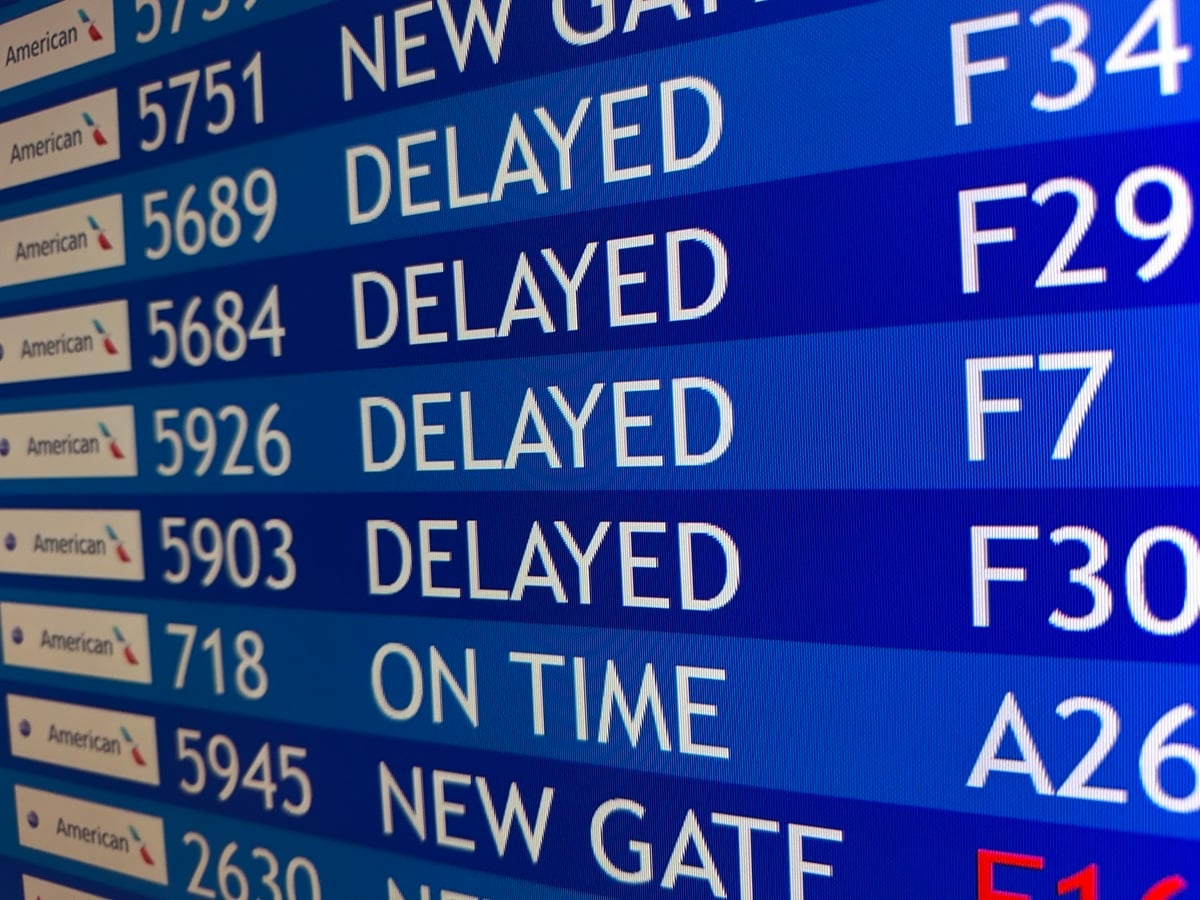 When she told me the Federal Aviation Administration (FAA) had issued a nationwide ground stop, I was shocked. This is only the third time in U.S. history that we’ve experienced a nationwide ground stop, with the most devastating, of course, being on September 11, 2001.
The first thing that crossed my mind was whether this could be a cyberattack, especially since my email was down for almost the entire day yesterday due to a widespread Microsoft Outlook outage. However, there’s currently no confirmed connection between the two incidents and officials have not announced that today’s ground stop was caused by a cyberattack.
Fortunately, Homeland Security Secretary Markwayne Mullin has offered some reassuring news. Mullin said there was no indication of a threat to the United States and confirmed that the ground stop was the result of a telecommunications outage. “There is no reason to be concerned about your loved ones if they’re flying,” Mullin said. See video below:
“There is no reason to be concerned about your loved ones if they’re flying.”
DHS Secretary Markwayne Mullin reassures travelers as a nationwide FAA ground stop sparks a flood of calls asking whether terrorism is to blame.
Responding to Fox News’ @pdoocy , Mullin says there is no indication of a threat to the U.S.
“This was a telecommunications outage.”
— Fox News (@FoxNews) November 13, 2026
That’s certainly reassuring, especially for those who, like my wife, were understandably alarmed by the initial news of a nationwide ground stop and the FAA’s reference to “extraordinary circumstances.”
Why has the FAA grounded flights nationwide?
The FAA issued a nationwide ground stop Friday afternoon, November 13, 2026, because of communications problems affecting air traffic control centers across the country. The FAA’s initial advisory said: “DUE TO EXTRAORDINARY CIRCUMSTANCES AND FOR REASONS OF SAFETY.”
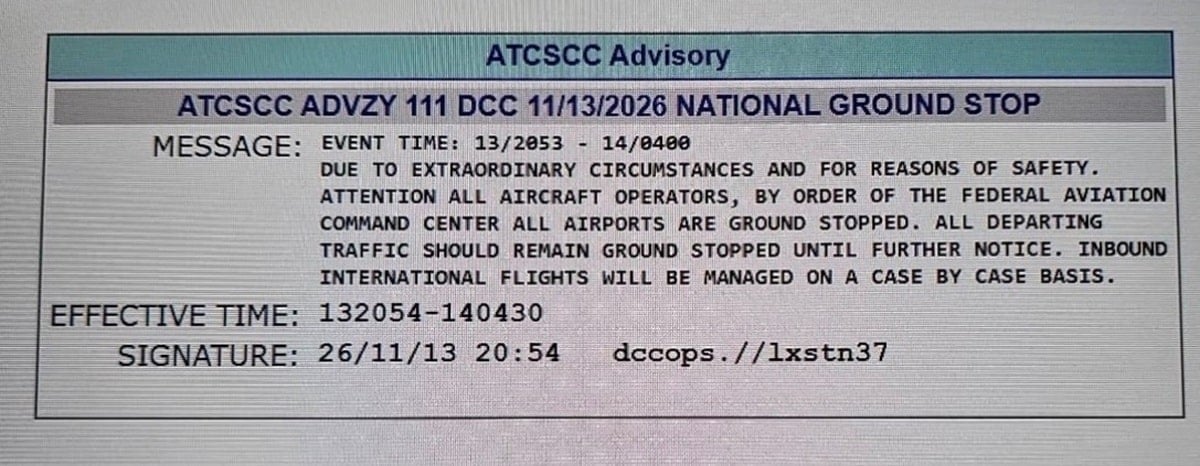
The advisory directed all departing aircraft to remain on the ground until further notice and said inbound international flights would be handled on a case-by-case basis.
According to the Associated Press, Transportation Secretary Sean Duffy said the communications issue is affecting the country’s 22 regional air traffic control centers, which are responsible for directing aircraft between airports. FAA technicians are investigating the problem.
The reassuring news is that this is a precautionary safety measure. Aircraft already in the air have not been ordered to land immediately, as they were on September 11, 2001.
The last nationwide ground stop occurred in January 2023, when a failure of the FAA’s Notice to Air Missions (NOTAM) system brought departures across the country to a temporary halt.
The federal government has been working to modernize the country’s aging air traffic control infrastructure, including replacing outdated communications equipment and copper wiring. Today’s incident is another reminder of just how important that work is.
What should travelers do right now?
Even when the FAA lifts the ground stop, don’t expect everything to return to normal immediately. Airlines will have to deal with aircraft and crews being out of position, missed connections and potentially thousands of delayed or canceled flights. Depending on how long this lasts, the ripple effects could extend well into the weekend.
If you’re traveling today or tomorrow, here are some things I recommend doing right now:
1. Check your flight status before heading to the airport
If you’re still at home or at your hotel, check your flight status before leaving for the airport. However, since this is a developing situation, airlines may not have updated their flight times yet. You can also check your departure airport’s website or social media accounts to see if flights are taking off. There’s no reason to spend hours sitting in a crowded terminal if you can avoid it.
Just remember that once the ground stop is lifted, flight schedules could change quickly, so keep monitoring your flight and follow your airline’s instructions about when to arrive at the airport.
You can also check the FAA’s National Airspace System Status for airport disruptions and FlightAware’s cancellation tracker to get a sense of how widespread the problems are.
2. Download your airline’s app and turn on notifications
If you don’t already have your airline’s app on your phone, download it now. Most airlines have invested heavily in their apps and you can often rebook a canceled flight without having to stand in a long line or wait on hold for hours.
Make sure your phone number and email address are associated with your reservation and that you’ve enabled push notifications. I always sign up for flight status notifications, including for loved ones when I’m picking them up at the airport.
One of my favorite travel apps is Flighty, which frequently alerts me to flight changes before the airline does. I also use TripIt to keep track of my travel plans.
3. Start looking at alternative transportation
I was watching CNN and one expert offered some excellent advice: If you’re sitting in an airport trying to get somewhere domestically, start looking for ground transportation. I couldn’t agree more.
If you’re traveling somewhere that’s within driving distance, start looking at rental cars, trains or buses. Depending on your route, you might be able to get to your destination faster by driving than by waiting for your airline to get you there.
Check Amtrak, FlixBus and rental car companies. If you decide to reserve a rental car as a backup, try to book a reservation that you can cancel without penalty and make sure you understand any one-way drop-off fees.
Remember, thousands of other travelers may have the same idea, so availability could disappear quickly.
4. Reserve a hotel room before they’re all booked
If it looks like you’re going to be spending the night at an airport, don’t wait until your flight is officially canceled to start looking for a hotel room. Depending on the city, thousands of stranded travelers could be competing for a limited number of rooms and hotel prices could increase significantly as availability dwindles.
I like to use HotelTonight for last-minute hotel reservations. You can also use your favorite hotel booking app or book directly with a hotel. Whenever possible, look for a refundable reservation so you can cancel it if your flight ends up operating.
Don’t count on the airline paying for your hotel. An FAA communications outage is generally outside an airline’s control, which means airlines may not be obligated to provide accommodations or meals.
5. Act quickly if your flight is canceled
If your flight is canceled and you can’t rebook using your airline’s app, get in line to speak with an agent as soon as possible. If you have access to an airline lounge, head there since the lines to speak with an agent are often much shorter.
At the same time, get on the phone with the airline. I’ve frequently been able to get rebooked by a phone agent before reaching the front of the customer service line.
IMPORTANT: Be extremely careful if you Google an airline’s customer service phone number. Scammers know how to manipulate search results and take advantage of desperate travelers, especially during major travel disruptions like this one.
Use the number listed in your airline’s official app or on its website. Here’s my list of airline phone numbers and websites and here’s what you need to know about this disturbing airline customer service scam.
6. Make sure you have food, water and a fully charged phone
If you’re stuck at the airport, don’t wait until you’re starving to get something to eat. Restaurants and shops could be overwhelmed with stranded passengers and some may close before you finally get on your flight.
Stock up on snacks, fill your reusable water bottle and make sure you have enough food, especially if you’re traveling with kids or have dietary restrictions.
Also, make sure your phone is fully charged. Your phone is your lifeline during a situation like this since you’ll need it to monitor your flight, make new reservations, contact loved ones and possibly arrange transportation.
This is another reason I always recommend traveling with a portable charger. The TESSAN portable charger with built-in cables is particularly handy since you don’t have to worry about carrying separate charging cords or finding an available electrical outlet in a crowded terminal.
7. Check your travel insurance and credit card benefits
Hopefully, you have travel insurance. I have an annual travel insurance policy from Allianz because my family and I travel so frequently. Depending on your policy, you may be covered for certain expenses associated with a lengthy travel delay, including meals, hotel accommodations and transportation.
If you purchased your airline ticket with a credit card that offers travel insurance, check your card’s benefits, too. Some cards offer trip delay reimbursement, which can help offset unexpected expenses.
Save all your receipts and any documentation from the airline explaining why your flight was delayed or canceled. And keep in mind that buying travel insurance after a disruption has already been announced generally won’t cover losses associated with that known event.
Full disclosure: I have previously worked as an ambassador for Allianz Global Assistance (AGA Service Company) and received financial compensation.
8. Know your rights if your flight is canceled
Under U.S. Department of Transportation rules, if your airline cancels your flight or significantly changes it and you choose not to travel or accept alternative transportation or compensation, you’re entitled to a refund.
That applies even if the cancellation is caused by something outside the airline’s control, such as an FAA ground stop.
However, if you voluntarily cancel a flight that is still scheduled to operate, you may not be entitled to a refund, depending on your ticket’s fare rules. That’s why it’s important to check your airline’s policies and any travel waivers before canceling your reservation.
You can learn more about your rights on the Department of Transportation’s website.
Most importantly, pack your patience
As frustrating as this situation is, remember that the FAA isn’t grounding flights to inconvenience travelers. It’s doing so for safety reasons, which is exactly what we want the agency to prioritize.
Please be kind to airline employees and airport workers. They’re dealing with the same unprecedented situation and are likely going to have a very long day.
I’ll be monitoring this developing story and will update it as more information becomes available. In the meantime, if you’re traveling today or this weekend, keep a close eye on your flight, have a backup plan and, most importantly, pack your patience.