

This post contains references to products from one or more of our advertisers. We may receive compensation when you click on links to those products. For an explanation of our Advertising Disclosure, visit this page.
I used to fly more than 150,000 miles a year, and after spending that much time on airplanes, I’ve seen just about every method and gadget passengers use to try to get some sleep.
Of course, everyone is different. Some people can fall asleep before the plane even leaves the gate, while others, like me, have to work at it. But after decades of frequent flying, I’ve figured out a few things that can make sleeping on a plane a whole lot easier.
Whether you’re taking a red-eye across the country or an overnight flight to Europe, here are 10 ways to help you sleep better on a plane.
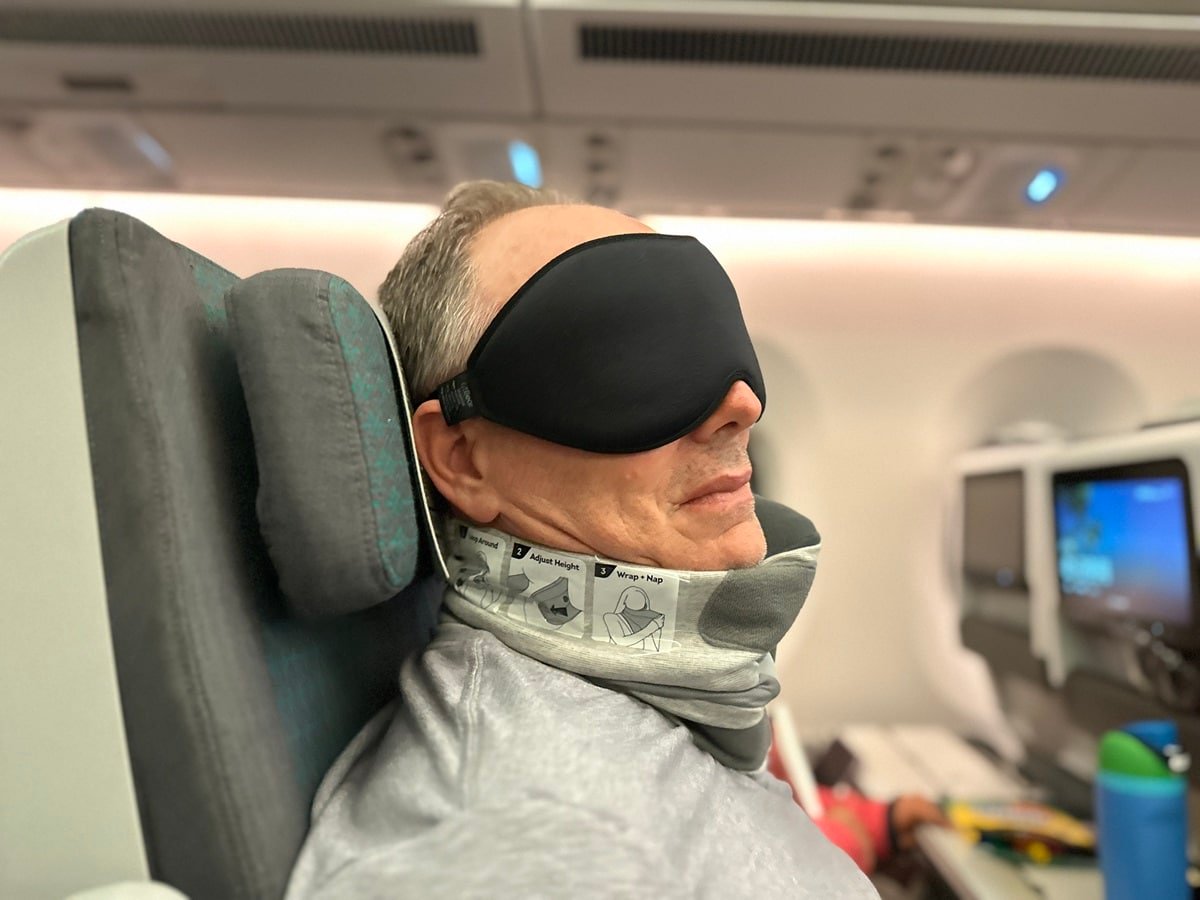 1. Bring a good eye mask
One of the easiest ways to improve your chances of sleeping is to block out as much light as possible. Cabin lights, reading lights, seatback screens and even your neighbor’s phone can make it difficult to fall asleep.
Instead of relying on the cheap, scratchy eye masks airlines sometimes hand out on long-haul flights, I bring my own comfortable one. My longtime favorite was a fluffy Lewis & Clark sleep mask, but these days I use a LitBear that my mother-in-law gave me. If you want something that blocks out virtually all light, the Manta Sleep Mask is another popular option. A good eye mask is inexpensive, takes up almost no room and can make a surprisingly big difference.
2. Pack earplugs
Earplugs are one of the smallest and cheapest things you can pack, and they can be invaluable on a flight. They help cut down on engine noise, conversations, announcements and the general hum of an airplane cabin. I always recommend keeping a pair in your carry-on or personal item rather than buried in your suitcase.
3. Use noise-canceling earbuds or headphones
Earplugs are great, but sometimes they aren’t enough. If there’s a crying baby, a loud conversation nearby or constant cabin noise, noise-canceling earbuds or headphones can be a lifesaver. I like to listen to relaxing music, white noise, an audiobook or something else that helps me wind down. Just make sure whatever device you’re using is charged before boarding, especially on a long overnight flight. And don’t forget to download your music, podcasts, audiobooks or meditation tracks before you leave home in case the plane’s Wi-Fi isn’t working.
4. Wear comfortable clothes and dress in layers
Airplane temperatures can be all over the place. One minute you’re freezing and the next you’re wondering why the cabin suddenly feels like a sauna. That’s why I always recommend dressing in comfortable layers that are easy to add or remove. On long-haul flights, some frequent business travelers change out of their work clothes after takeoff and into something more comfortable. You don’t necessarily need to bring pajamas, but loose-fitting clothing, a sweatshirt or sweater and a comfortable pair of socks can make it much easier to settle in.
5. Keep your seatbelt visible
Here’s a simple trick that can keep you from being unnecessarily awakened: Fasten your seatbelt over your blanket or outer layer of clothing. If the seatbelt sign comes on while you’re sleeping, flight attendants need to make sure you’re buckled up. If they can clearly see your seatbelt, they won’t need to wake you to check.
6. Bring your own food and water
If your goal is to sleep, don’t let the airline’s meal schedule dictate when you can close your eyes. On an overnight flight, I often prefer to eat before boarding or bring something with me so I don’t have to wait for the meal service.
Depending on the flight, it can be well over an hour after taking off before the crew starts serving food. Bring an empty reusable water bottle through security and fill it before boarding or buy a bottle of water in the terminal. Staying hydrated is important, but I also wouldn’t overdo it right before trying to sleep unless you want to spend half the flight getting up to use the bathroom. And while a glass of wine might seem like a good way to help you fall asleep, alcohol can interfere with the quality of your sleep and contribute to dehydration.
7. Choose a window seat
If sleeping is your priority, I usually recommend a window seat. You have something to lean against, you control the window shade and, most importantly, you don’t have to get up every time one of your seatmates needs to use the bathroom.
Before choosing your seat, check your airline’s seat map and a site like AeroLOPA, which has detailed aircraft seating charts. Pay attention to seats near bathrooms and galleys since those areas tend to have more light, noise and foot traffic. If you know you’re going to sleep for most of the flight, a window seat away from those high-traffic areas is usually your best bet.
8. Let people know you want to sleep
If you don’t want to be awakened for a meal or drink service, politely let the flight attendant know before you go to sleep. You can also mention it to your seatmate, especially if you’re in an aisle or middle seat. If you’re sitting by the window and your seatmate plans to sleep too, even better. Everyone can settle in without wondering who’s going to need to climb over whom two hours later.
9. Bring a travel pillow or something comfortable to lean on
There are countless travel pillows on the market, from traditional U-shaped neck pillows to inflatable pillows and newer designs that wrap around your neck or attach to the seat. I’ve tried a number of them over the years and the truth is that there’s no single travel pillow that’s best for everyone. Here’s my picks for neck pillows.
The important thing is to find one that’s comfortable for the way you sleep. A lightweight blanket, shawl or oversized sweater can also help. Some airlines still provide blankets on long-haul flights, particularly in premium cabins, but I wouldn’t count on having one. If you tend to get cold, bring something you know will keep you comfortable.
10. Be very careful with sleep aids
I’m personally not a fan of taking sleeping pills. I prefer to remain aware of my surroundings in case of turbulence or an emergency, and I never recommend experimenting with a new medication for the first time at 35,000 feet. Some travelers use melatonin or prescription sleep medications, but these aren’t right for everyone and can have side effects. Alcohol can also interact dangerously with some medications. If you’re considering taking a sleep aid for a flight, talk to your doctor first and find out whether it’s appropriate for you. And never take more than directed just because you aren’t falling asleep as quickly as you’d hoped.
Bonus tip: Start thinking about sleep before you board
One thing I’ve learned over the years is that getting decent sleep on a plane starts before you get on it. If you’re racing through the airport, stressed out, hungry, dehydrated and trying to answer emails right up until takeoff, it’s going to be much harder to suddenly switch your brain into sleep mode.
For an overnight flight, I try to get settled as quickly as possible. Have everything you’ll need for sleeping within reach before you board: eye mask, earplugs, headphones, charging cable, sweater, pillow and water. That way, once you’re in the air, you’re not digging through the overhead bin trying to find something.
No airplane seat is ever going to feel quite like your bed at home, but a little preparation can make the difference between arriving completely exhausted and getting at least a few decent hours of sleep.
What works for you? Do you have a favorite travel pillow, sleep mask or other gadget that helps you sleep on a plane? Leave your tips in the comments below.
*This post was originally published in 2013 but has been updated.
Want more travel news, tips and deals? Sign up to Johnny Jet’s free newsletter and check out these popular posts: The Travel Gadget Flight Attendants Never Leave Home Without and 12 Ways to Save Money on Baggage Fees. Follow Johnny Jet on MSN, Facebook, Instagram, Pinterest, and YouTube for all of my travel posts.

Johnny, Thanks for the tips, finally get some sleep)
I am a poor plane sleeper – which is tough luck at 100k/yr. I am always trying something different hoping to hit on some method to sleep but not so desperate as to take Ambien. it is probably different for everyone, but for me, putting my feet up buys me a couple of hours for some reason. Jonny’s roller bag trick under the feet is brilliant and works great for me. Even without a bulkhead I will put something under my feet to raise them the extent that I can.
My newest experiment is a really small shiatsu massager that I have used when I have a plug. Ten minutes of that can get me in the mood and if I don’t end up sleeping, I find it was worth the space it takes in my bag just to find taht level of relaxation. I almost always check a bag so I have the room in my carry on.
Most helpful for me is just not to worry so much about how uncomfortable the trip might be and just recognize exactly what you are doing when you travel by air, which is quite amazing, really. Nowadays we enjoy and abuse our privileges. Next time you find yourself in an uncomfortable seat, in your mind compare conditions of the trip with what you would have had to endure 200 years ago. Besides the time required and abject discomfort, a member of your family actually might not have made it. Kind of like counting your blessings like sheep. for most of us you will fall asleep before you exhaust that list.
Ambien has its medical uses and thank God for that -but to use it to catch some sleep on a plane seems short-sighted. It works by temporarily (I hope) interrupting the brain’s ability to store memories. That takes a little while to ‘half-life’ away in the morning. I worked with a guy whos ‘doctor’ prescribed it for him on a nightly basis. He could not remember half the things we talked about, and worse, forgot the things we took time together to plan and decide. Absolutely annoying. He might have been happy but the people around him were not.
When it comes to me, I’ve always relied on my playlist which actually makes me sleep. This is different from songs I listen any other time. Anyways, thanks for this post, Johnny! Will try some of these too and let you know if it works for me.
Excellent tips. Here’s another: Bring a pair of slippers or flip flops. This way you can take off your shoes – also, be more comfortable.
Another really cool tip! A hat is a really useful tool I always ensure I bring on a flight. Often the air conditioning is way too cold beating down on your head to induce for a proper sleep environment. Along with the sleeping mask, neck pillow and a hat, you got a recipe for a good flight’s sleep!
A few additional comments. Regarding food and drink – if you have a chance to have something light in the airport (salad, etc…) that’s a good option rather than waiting for taxi, drink service, then food service. Also – try to take a longer flight if going to Europe. I fly to Dublin often. The non-stop from Atlanta is a full two hours longer than the non-stop connection from JFK. Those extra two hours can translate to more sleep. A few years ago I was about three rows back in Delta Comfort – International. They had a change of aircraft and changed my seat (which I learned at boarding.) The “new” seat was adjacent to the lavatory and the door was slammed about every 2-3 minutes for pretty much the entire flight. So “avoid seats near the lavatory” would be good advice. Finally if you use a CPAP machine when you sleep consider a portable unit which is rated for use in-flight. Can be powered by a power port or optional battery. And especially handy when you’re on the road.
the best thing that I’ve found that has worked for me is white noise. Major tip for most people.
I’ve travelled over a hundred thousand miles as well. My favourite picks on this list are the noise cancelling headphones and wearing comfortable clothes. The sleeping pills are an overkill, you might end of sleeping through an emergency!!
I believe these are major tips and applicable to most people. I agree that one should avoid taking sleeping pills and stick to healthy sleep. Thank you for these tips!
Honestly I just use melatonin on those long flights- works like a charm. It’s also non drozy compared to other meds. Great post johnny!
In regards to the noise -cancellation speakers etc. – the best thing that I’ve found that has worked for me is white noise. You can just google white noise and keep that as a track playing in the background. Highly recommend it as it’s evens scientifically proven to help drown out the extra noise especially in a plane.
Cheers!
This is a good recommendation. Since we usually feel exhausted when traveling. I use to lean my back on my chair, but if I had my traveling pillow, it would be nice. Overall this is nice.