

This article was produced in partnership with TESSAN and contains affiliate links. We may receive compensation if you click on or make purchases through those links.
You check into your hotel after a long travel day, drop your bags and reach for your phone charger. Then the search begins.
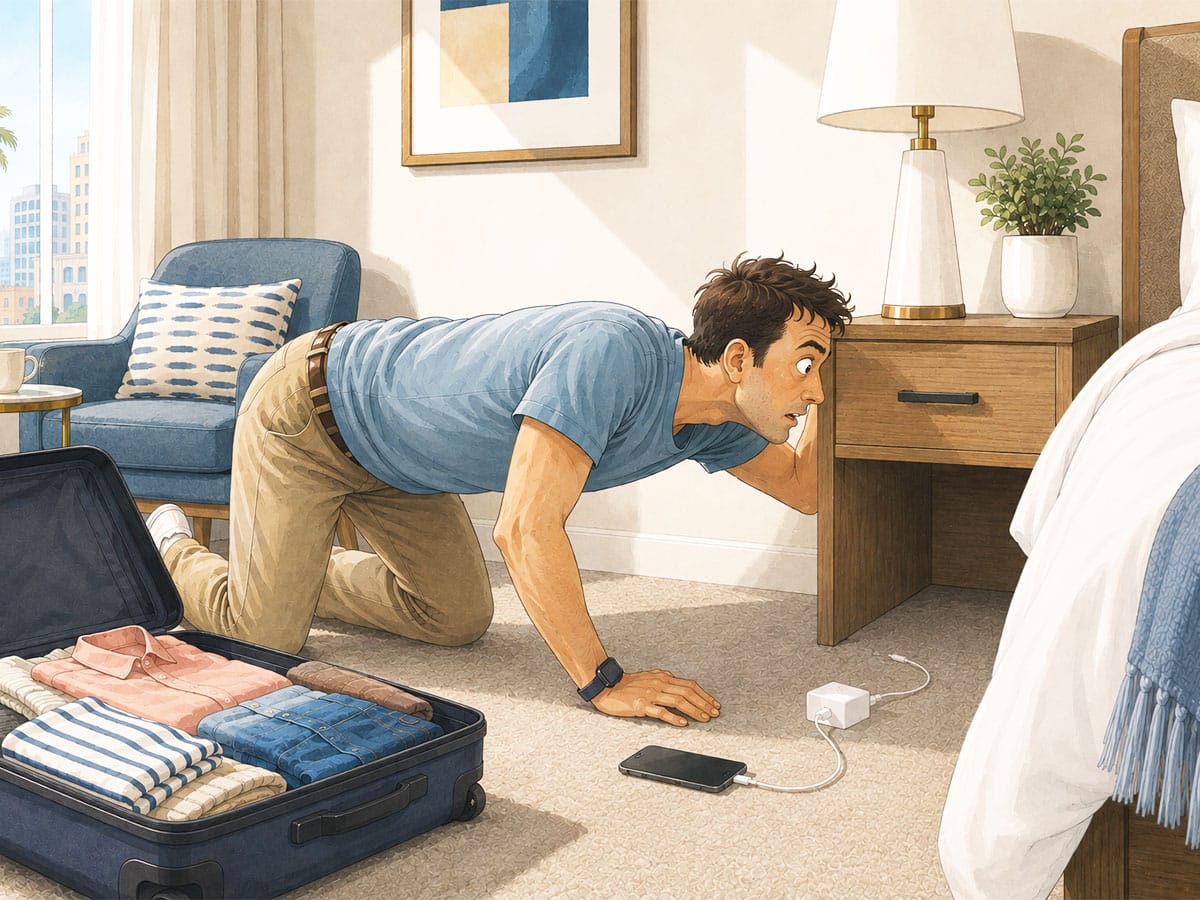
There’s an outlet behind the desk, already occupied by a lamp. Another is hidden behind the bed. The only free socket is across the room, nowhere near the nightstand. And somehow two people are supposed to charge two phones, a smartwatch, earbuds, a laptop and maybe a camera before morning.
For all the ways hotels have modernized, access to power remains surprisingly inconsistent. And the problem isn’t limited to hotels. Vacation rentals, airports and cruise cabins can leave travelers playing the same frustrating game.
The good news is that a little planning (and well-chosen charging accessories) can make the nightly outlet hunt much easier.
Why Hotels Are Still Short on Outlets
The simplest explanation is age. Many hotels were designed or built long before the average guest traveled with several rechargeable devices. A bedside outlet may once have been needed for little more than a lamp or alarm clock. Today, that same guest might want to plug in a phone, watch, tablet, laptop and headphones overnight.
Renovating an older property doesn’t necessarily solve the problem. Adding electrical outlets can require considerably more work than replacing furniture or updating décor, so some renovated rooms still rely on electrical layouts created for a very different era.
Even newer properties can fall short. A room may technically have plenty of sockets, but that doesn’t mean they’re where guests need them. An outlet behind a heavy bed frame isn’t particularly useful. Neither is one across the room when you want your phone charging beside you overnight.
The Problem Isn’t Just Hotels
Vacation rentals can be even less predictable. You may be staying in an older apartment, cottage or house where outlet placement reflects the needs of permanent residents decades ago, not a family arriving with a suitcase full of electronics.
Airports present a different challenge. Charging stations have become more common, but demand can easily exceed supply at a busy gate. The coveted seat beside the outlet is rarely available exactly when your battery turns red.
Then there are cruise ships, where cabins are compact and outlets can be limited. Cruise lines also have their own rules about what electrical accessories passengers can bring aboard, so travelers need to check their particular line’s current prohibited-items policy before packing a power strip or extension cord.
The common thread is simple: Travelers carry more rechargeable devices than many travel environments were designed to accommodate.
First, Take Inventory of What You Actually Charge
Before solving the outlet problem, figure out what exactly you need. For a solo traveler, the nightly lineup might be a phone, smartwatch and earbuds. A business traveler might add a laptop and tablet. Couples and families can easily arrive with half a dozen or more devices competing for power.
Lay everything out before you pack and count both the devices and the types of connections they require. If most of your electronics now use USB-C, you may be able to dramatically simplify your setup rather than bringing a separate wall charger for each device.
The goal isn’t to pack more charging equipment. It’s to make one available outlet do more.
Pack a Compact Power Strip for Hotel Stays
For trips within the U.S., one of the simplest solutions is a small power strip that turns a single accessible outlet into a central charging station.
This small flat plug power strip is particularly well suited to hotel rooms because it has three AC outlets plus two USB-A ports and one USB-C port, allowing up to six devices to connect at once. Its 5-foot cord also helps solve a second hotel problem: outlets that aren’t conveniently located next to the bed or desk.
The plug itself is ultra-thin and designed to sit close to the wall, which can be useful when the only accessible socket is tucked behind furniture. And at roughly the size of a small charging block, the power strip doesn’t require much suitcase space.
One caveat: This particular model is intended for 125V U.S. outlets and is not a voltage converter, so it shouldn’t simply be plugged into an international outlet without checking compatibility.
Turn One Convenient Outlet Into Your Charging Zone
Once you have a way to expand a single outlet, resist the temptation to scatter electronics around the room.
Instead, create one charging zone, ideally on a desk, dresser or nightstand. Plug in your power strip and charge phones, watches, earbuds and other small devices in one place.
There’s a practical benefit beyond convenience: You’re less likely to leave something behind.
A charging cable plugged into an outlet behind a nightstand is remarkably easy to forget. So are earbuds charging beside a hotel television. Keeping everything together gives you one place to check before you zip your suitcase.
For couples and families, a central station also eliminates the nightly negotiation over who gets the bedside outlet.
Use USB Ports Strategically
One reason travelers run out of outlets so quickly is that every USB device comes with its own charging block.
If your power strip or charger already includes USB ports, you may not need all those individual wall adapters. Your phone, watch or earbuds may be able to plug directly into the charging station, leaving the AC outlets available for laptops, camera chargers or other equipment that needs them.
There is an important distinction, though: A USB-C port doesn’t automatically mean high-powered fast charging. The TESSAN Small Flat Plug Power Strip, for example, has a maximum combined USB output of 15W, so it’s better suited to phones and smaller electronics than to fast-charging a power-hungry laptop directly from its USB-C port.
For a laptop, use the appropriate manufacturer-compatible charger plugged into one of the AC outlets.
What About International Trips?
International travel adds two questions to the equation: Will my plug fit and will my device support the local voltage?
Those are not the same problem.
A plug adapter changes the physical connection so your plug can fit a foreign socket. It does not necessarily convert electricity from one voltage to another.
Check the voltage information on every device or charger you plan to use. Many modern phone and laptop chargers accept a broad input range, but travelers should never assume that every electrical item does.
For international itineraries, a universal travel adapter with multiple USB ports can often make more sense than a U.S.-style power strip. It gives you the appropriate plug configuration while also letting one wall outlet handle several devices.
Be Especially Careful on Cruises
Cruise cabins are one place where travelers should not assume that the power strip they use in a hotel will be allowed onboard.
Policies vary by cruise line and can change. Some prohibit surge protectors, while others restrict extension cords or multi-plug devices more broadly. Even a product marketed for cruise travel may not comply with every cruise line’s rules. Before packing any power strip, check the prohibited-items page on your cruise line’s official website for your specific sailing.
Don’t Forget the Airport Problem
If you’re working during a long layover, arrive at the airport with your devices charged rather than counting on finding power at the gate. A portable power bank is also useful when your phone is doing heavy duty as a boarding pass, entertainment system, wallet and connection to the airline app.
When you do find an airport outlet, a multi-outlet charging setup can be useful—but be considerate. Don’t monopolize the available power if other passengers need it. The smartest travel charging strategy is the one that gives you more independence from public outlets, not a way to claim all of them.
A Few Charging Mistakes to Avoid
Convenience shouldn’t come at the expense of safety so follow these tips:
Don’t overload a power strip and avoid using one for high-wattage appliances beyond its rated capacity.
Don’t daisy-chain power strips or extension cords together. And when traveling internationally, never assume a plug adapter or power strip is also a voltage converter.
Finally, inspect chargers and cables before packing. A frayed cable or damaged plug isn’t worth bringing just because it still technically works.
The Smart-Traveler Solution Is Surprisingly Simple
Hotels may eventually catch up with the number of devices guests carry. Many newer and renovated rooms already include bedside outlets and USB ports.
Until that becomes universal, travelers are better off assuming that convenient power will be limited.
You don’t need to fill your suitcase with charging equipment. For many U.S. hotel stays, something as compact as the TESSAN Small Flat Plug Power Strip can turn one awkwardly placed outlet into a charging station for several devices—and its 5-foot cord can bring the power closer to where you actually need it.
Add the right cables and, when appropriate, a portable power bank like this one, and you’ve solved one of travel’s most persistent little annoyances before you even check in. Because after a long day of traveling, the last thing anyone wants to do is crawl behind a hotel nightstand looking for somewhere to charge a phone.


I was at a destination wedding staying in the farmhouse, which was modern. The only convenient outlet was on the wall outside of the bathroom down low across from the bed so I could either leave the phone on the floor and maybe step on it, on the back of the toilet, or I had put on the bed but getting ready for events I was in and out of the bathroom so I kept having to step over the cord. What if there were 2 of us in the room? At least provide something to make it easier to charge devices.
Outlets in the base of lamps in chain hotels are frequently worn out and won’t make good electrical contact, if at all. Chain hotel managers don’t seem to care. To solve the problem consider something like a 4 in 1 extension cord power splitter with a separate power cord for each outlet. Note: Cruise ships strictly ban standard surge-protected power strips because they interact poorly with a ship’s isolated electrical grid and pose a severe fire hazard.