I’ve spent much of my life traveling through airports around the world, and after decades of flying, I thought I knew just about everything there was to know about them. Boy, was I wrong.

I recently came across a fascinating discussion on Threads that started with a simple question from @imincredipaul: “I want to hear airport fun facts. I’ll start. The Cincinnati, Ohio airport is actually in Kentucky.”
View on Threads
That caught my attention because I knew firsthand that it was true! I’ve flown into Cincinnati/Northern Kentucky International Airport (CVG) multiple times to attend the Kentucky Derby because flights there were much cheaper than flying directly into Louisville. And yes, despite serving Cincinnati, Ohio, the airport is actually across the state line in Kentucky.
The post quickly turned into a fascinating collection of airport trivia, with travelers sharing everything from unusual attractions and bizarre airport histories to little-known facts that sound completely made up. Some of the comments were so surprising that I had to look them up myself, and once I started researching, I discovered even more interesting airport facts. Here are 14 that might surprise you, even if you’re a frequent flyer.
1. Cincinnati’s airport isn’t actually in Ohio
Let’s start with the fact that inspired this whole article. Despite its name, Cincinnati/Northern Kentucky International Airport (CVG) is located in Hebron, Kentucky, about 13 miles south of downtown Cincinnati. As I mentioned above, I’ve used it as an alternative to Louisville when attending the Kentucky Derby, and depending on airfare, it can be a great money-saving option if you don’t mind the extra drive.
Here’s another interesting detail: The airport’s three-letter code, CVG, comes from Covington, Kentucky, rather than Cincinnati. So the next time someone tells you they’re flying into Cincinnati, you can point out that they’re technically landing in another state. Source: Cincinnati/Northern Kentucky International Airport
2. There’s an airport runway with graves embedded in it
This might be the strangest airport fact on the entire list. At Savannah/Hilton Head International Airport (SAV) in Georgia, two grave markers are embedded in an active runway. They belong to Richard and Catherine Dotson, who lived on the property long before it became an airport.
When the airport expanded during World War II, the government needed land that included the family’s cemetery. Most of the graves were relocated, but Richard and Catherine’s graves remained. Today, their grave markers are embedded near the edge of Runway 10/28, while two additional Dotson family graves remain nearby.
3. Detroit’s airport has a 700-foot tunnel with a light and music show
If you’ve ever connected through Detroit Metropolitan Airport (DTW), you might already know about this one. The McNamara Terminal features a 700-foot underground tunnel connecting Concourse A with Concourses B and C, but this isn’t your ordinary airport walkway.
The tunnel features colorful LED lights, nearly 9,000 feet of illuminated glass panels and an original musical score that create an immersive light-and-sound experience as travelers move along the walkways. Even more interesting, the tunnel runs underneath two active airport taxiways, meaning aircraft could be taxiing right above you.
What you might not know, is there’s an accessibility feature: Travelers who are sensitive to the lights or sounds can press a button at either end of the tunnel to temporarily suspend the show for five minutes.
Source: Detroit Metropolitan Airport
4. Denver’s airport has a giant blue horse with glowing red eyes
If you’ve ever driven into Denver International Airport (DEN), you’ve probably noticed the enormous blue horse standing alongside the road. The 32-foot-tall fiberglass sculpture is officially called Mustang, but locals have given it a much more memorable nickname: Blucifer.
Created by artist Luis Jiménez, the sculpture features an electric-blue body and glowing red eyes. Its dramatic appearance has inspired plenty of jokes, theories and conversations among travelers, and it’s certainly not your typical welcome-to-the-airport artwork.
Source: Denver International Airport
5. You can play golf while waiting for a flight in Minneapolis
If you have a long layover at Minneapolis-St. Paul International Airport (MSP), you can work on your golf swing without leaving the terminal. The airport has a PGA-branded golf facility in Terminal 1 where travelers can practice on simulators, play virtual versions of famous courses and even receive instruction from PGA professionals.
There’s also a virtual driving range and putting green. It’s one of those airport amenities that makes you wonder why more airports don’t offer something similar.
Source: Minneapolis-St. Paul International Airport
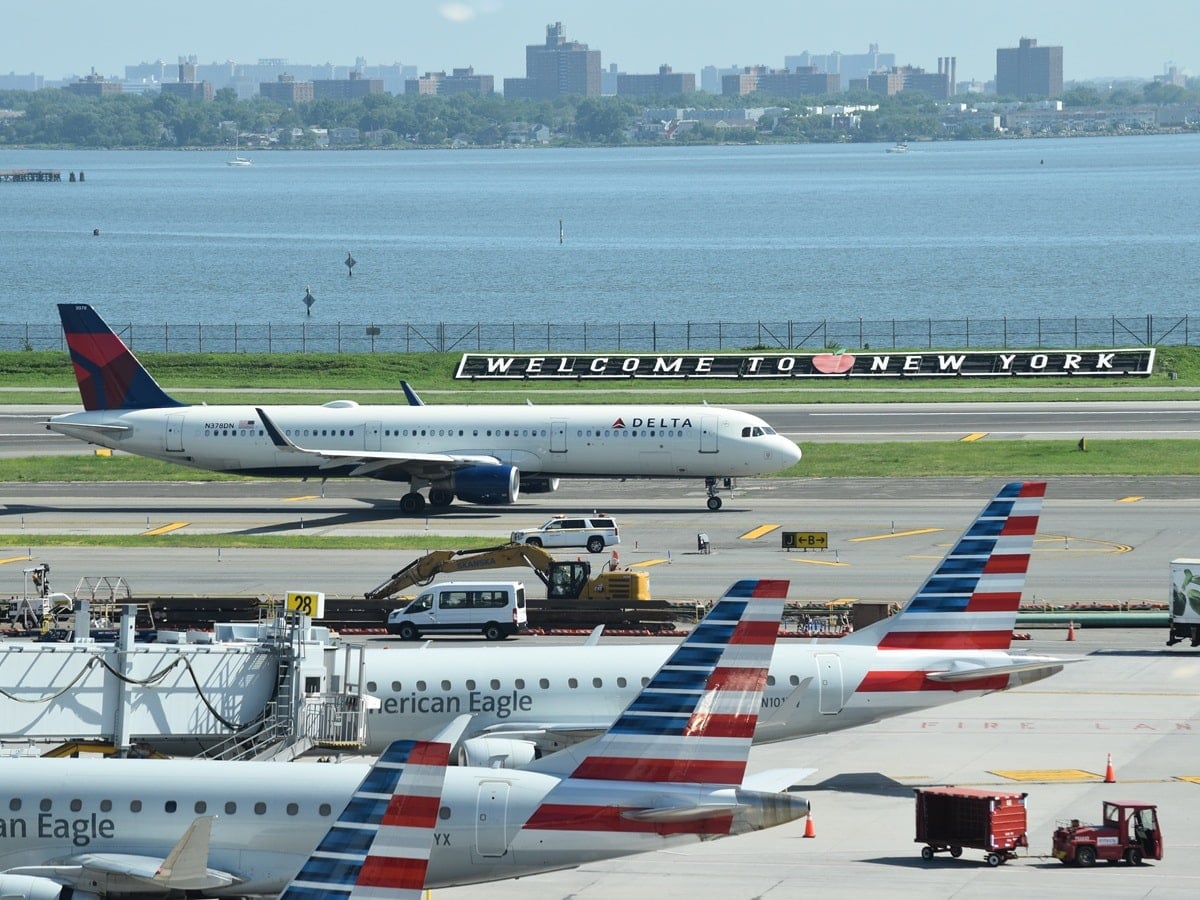
6. LaGuardia has a rule limiting how far most nonstop flights can travel
Here’s a fun fact that even some frequent flyers might not know. New York’s LaGuardia Airport (LGA) has long operated under what’s known as the perimeter rule, which generally restricts nonstop flights to destinations within 1,500 miles.
There are notable exceptions, including Denver and flights operating on Saturdays. That’s why you don’t normally see nonstop LaGuardia-to-Los Angeles or San Francisco flights during the week, even though those routes would presumably be popular. The rule helps shape how air traffic is distributed among the New York area’s airports and has been the subject of plenty of debate over the years.
7. You can clear U.S. Customs before leaving certain foreign airports
Here’s one that’s not only interesting but useful for travelers. At select airports in Canada, Aruba, Bermuda, the Bahamas, Ireland and even Abu Dhabi in the United Arab Emirates, passengers flying to the United States can clear U.S. Customs and immigration before boarding their flights. I’ve personally used this service in the first five destinations and have also flown through Abu Dhabi, although that was before preclearance was introduced there.
The process is called U.S. preclearance, and it means you generally arrive in the United States like a domestic passenger without having to go through immigration and customs again. It’s a great time-saver, especially when you have a connecting flight. Just remember that preclearance can add time to the departure process, so arrive at the airport earlier than you normally would.
Source: U.S. Customs and Border Protection — Preclearance
8. Austin’s airport used to be an Air Force base
Austin-Bergstrom International Airport (AUS) has a fascinating military history. Before becoming a commercial airport, the property was home to Bergstrom Air Force Base, which operated for decades before closing in the 1990s. The city transformed the former military installation into a commercial airport, which opened in 1999.
Even more interesting, the Hilton Austin Airport occupies the former Air Force headquarters building. Its unusual circular design earned it nicknames including “The Donut” and “The Little Pentagon.”
9. Washington Dulles Airport is almost the size of a small city
Washington Dulles International Airport (IAD) is enormous. According to the airport, it occupies approximately 11,184 acres, or about 17.5 square miles.
To put that into perspective, Washington, D.C., has a land area of approximately 61 square miles. That means the airport’s property is equivalent to more than a quarter of the capital’s land area. Of course, not all that space is used for runways and terminals, but it’s still an incredible amount of land for one airport.
Source: Washington Dulles International Airport
10. Portland’s airport carpet became so famous that travelers protested when it was replaced
Most travelers don’t pay much attention to airport carpeting, but Portland International Airport (PDX) is a different story. Its distinctive carpet pattern, introduced in 1988, became a local celebrity, with travelers taking photos of their shoes against it and the design eventually appearing on clothing, souvenirs and other merchandise.
When the airport announced plans to replace the aging carpet, the news generated an unexpectedly emotional reaction. The design was so popular that the airport eventually brought it back. And here’s another fun detail: The original pattern was inspired by the layout of the airport’s runways.
Source: Portland International Airport
11. Singapore’s airport has the world’s tallest indoor waterfall and airport slide
Singapore Changi Airport (SIN) is famous for its attractions, including the Rain Vortex at Jewel Changi Airport, the world’s tallest indoor waterfall. It stands approximately 131 feet tall and cascades through the center of a massive glass-domed complex.
But that’s not the airport’s only record-breaking attraction. Terminal 3 is home to The Slide@T3, the world’s tallest slide inside an airport, standing four stories (39 feet) tall. I’ve actually gone down it myself, and it’s a lot of fun! I’ve always said some airports are destinations in themselves, and Changi is a perfect example.
Sources: Changi Airport — Rain Vortex | Changi Airport — The Slide@T3
12. Baltimore’s airport has a giant stained-glass blue crab
If you’re flying through Baltimore/Washington International Thurgood Marshall Airport (BWI), keep an eye out for a massive blue crab sculpture. The stained-glass artwork measures approximately 10 feet by 7 feet by 5 feet and weighs around 550 pounds.
It’s a tribute to Maryland’s famous Chesapeake blue crab and is located in the skywalk overlooking Security Checkpoint A. It’s also a great example of how airports use artwork to introduce travelers to the local culture before they even leave the terminal.
Source: BWI Marshall Airport
13. San Francisco International Airport has an accredited museum
Here’s something I bet many travelers rushing through SFO don’t realize. San Francisco International Airport is home to SFO Museum, which became the first museum located inside an airport to receive accreditation from the American Alliance of Museums.
The museum features rotating exhibitions throughout the terminals covering everything from aviation history to art, photography and science. There’s also an Aviation Museum and Library in the International Terminal, so if you have extra time before a flight, it’s worth checking out.
Source: SFO Museum
14. Amsterdam’s airport is actually below sea level
Here’s surprising fact about Amsterdam Schiphol Airport (AMS). The airport sits on land that was once covered by Haarlemmermeer Lake, which was drained in the 19th century before an airport was eventually built on the reclaimed land. Today, Schiphol sits roughly 13 feet below sea level. Think about that the next time you’re landing in Amsterdam: You’re touching down at an airport built on what was once the bottom of a lake.
Source: Amsterdam Airport Schiphol
What airport fact did I miss?
After decades of traveling, I still love discovering unusual things about airports. What started as a simple Threads discussion turned into a fascinating reminder that airports have some pretty incredible stories hiding in plain sight.
There’s a lot more to airports than security lines, boarding gates and baggage carousels. Now I’m curious: What’s the most unusual airport fact you know? Have you visited any of the airports on this list or discovered something surprising during your travels?
Share your favorite airport trivia in the comments. I’d love to hear it and might even add some of the best discoveries to this article.